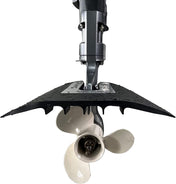
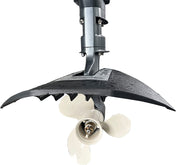
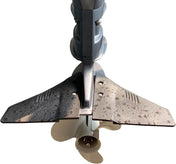
Yamaha 4-Stroke 9.9-40HP Outboard Engine Parts
(1 products)This page is dedicated to Yamaha 4‑Stroke 9.9–40HP outboard engines and helps you quickly find compatible parts and service information. Below you’ll find maintenance tips, common replacement parts, and troubleshooting guidance. You can also browse the main Yamaha collection any time. Scroll to the bottom of this page to start browsing parts for your engine, and remember that on the collection page you can use the Filter & Sort controls to narrow results by horsepower, year range, and part category/section.
Browse All Yamaha PartsHow to Identify Your 9.9–40HP Model
- Locate the nameplate/serial plate on the transom bracket (usually starboard side). Record the full model code and serial number.
- Model codes for Yamaha four‑strokes typically start with “F” (e.g., F9.9, F20, F40). Suffix letters indicate features like shaft length (S=15", L=20", X=25"), control type (H=tiller, R=remote), and sometimes trim/tilt (T).
- Year is often encoded as a trailing letter in some older codes; for exact parts matching, use the full model code and serial number rather than assuming by year alone.
- Within 9.9–40HP, smaller portable twins (F9.9/F15/F20–25) differ from mid‑range inline‑3 models (F30/F40). Many parts are platform‑specific, so confirm your exact model family.
Platform Overview
Portable Twins (F9.9/F15/F20–25)
| Feature | Description |
|---|---|
| Configuration | 2‑cylinder SOHC 4‑stroke; earlier units commonly carbureted, later F20/F25 variants may use EFI. |
| Common Models | Examples: F9.9SMH, F15LEH, F20LMH, F25LA. |
| Advantages | Lightweight, portable, smooth trolling, low fuel consumption. |
| Notes | Water pump/gearcase parts vary by gearcase size and year. Always verify by full model code and serial number. |
Mid‑Range Inline‑3 (F30/F40)
| Feature | Description |
|---|---|
| Configuration | Inline‑3 4‑stroke; early versions may be carbureted, later models commonly EFI. |
| Common Models | Examples: F30LA, F40LA (remote or tiller variants; various shaft lengths). |
| Advantages | Good mid‑range torque, quiet operation, strong efficiency for small craft and pontoons. |
| Notes | Some components interchange between F30 and F40, but cooling, intake, and prop/gear ratios may differ. Confirm by model code. |
Routine Maintenance & Service Parts
Intervals below are general guidelines for Yamaha four‑stroke outboards. Always follow the maintenance schedule in your engine’s official service manual.
| Item | Interval* | Remarks | Parts Link |
|---|---|---|---|
| Engine oil + filter | After first 20 hrs, then every 100 hrs or annually | Use marine‑rated 4‑stroke oil meeting Yamaha specs; replace filter at each oil change. | Yamaha Service & Maintenance Kits |
| Gear oil (lower unit) | Every 100 hrs or annually | Inspect for water intrusion/metal. Replace seals if contamination is found. | Yamaha Lower Unit Seal Kits |
| Spark plugs | Inspect 100 hrs; replace as needed (often 300 hrs) | Check gap and condition; replace if fouled or out of spec. | Spark Plugs |
| Fuel filter / water separator | Inspect every 50–100 hrs; replace yearly | More frequent service in ethanol or harsh environments. | Fuel Filters |
| Water pump impeller/kit | Inspect annually; replace every 2–3 seasons or 200 hrs | Replace sooner if weak telltale, overheat alarms, or sand/silt use. | Yamaha Water Pump Repair Kits |
| Anodes (zincs) | Inspect every 50 hrs or quarterly; replace when 50% depleted | Match anode material to water type (zinc, aluminum, magnesium). | Yamaha Anodes |
Frequently Used Parts Categories
- Routine Service — Yamaha Service & Maintenance Kits
- Cooling System — Yamaha Water Pump Repair Kits
- Lower Unit Seals — Yamaha Lower Unit Seal Kits
- Fuel System — Fuel Filters
- Ignition / Electrical — Electrical Items
- Corrosion Protection — Yamaha Anodes
- Propulsion — Yamaha Propellers
Common Symptoms & Quick Checks
| Symptom | Check First | Related Parts |
|---|---|---|
| Weak telltale or overheat alarm | Inspect intake screens for debris; verify impeller condition; confirm thermostat operation. | Water pump kit, intake screen, thermostat, gaskets |
| Poor acceleration or loss of power | Check for fouled prop, old fuel, clogged fuel filter, restricted vent; inspect spark plugs. | Propeller, fuel filter, spark plugs, fuel lines |
| Hard starting or rough idle | Prime the bulb; verify choke/EFI enrichment; inspect plugs and idle air passages; ensure strong battery. | Spark plugs, fuel filter, injector/carb service parts, battery/starter |
| Gearcase noise or metal in gear oil | Check oil level/condition; look for water intrusion; inspect prop shaft seals and bearings. | Gear lube, seal kit, bearings, drain screw gaskets |
FAQs
Are parts interchangeable between different years or platforms?
Some items interchange (e.g., filters or anodes), but many components differ between portable twins and inline‑3 models and across years. Always confirm by full model code and serial number before ordering.
When should I replace the impeller?
Inspect annually and replace every 2–3 seasons or about 200 hours. Replace sooner if the telltale weakens, you operate in sandy/silty water, or after any overheat event.
How often should gear oil be changed?
Every 100 hours or annually. If oil appears milky, smells burnt, or contains metal, service the gearcase immediately and replace seals as needed.
What information do you need to confirm part compatibility?
Provide the complete model code, serial number, shaft length, and control type (tiller or remote). Photos of the nameplate and the part to be replaced are very helpful.
Browse the main Yamaha collection to filter by horsepower, year, and model, then drill into the parts you need.
Shop Yamaha Outboard PartsIf you’re unsure about your model, send us a photo of the nameplate and the part you need and we’ll help verify compatibility.
- Most relevant
- Best selling
- Alphabetically, A-Z
- Alphabetically, Z-A
- Price, low to high
- Price, high to low
- Date, old to new
- Date, new to old

SeaSierra
Inline Fuel Filter – Yamaha/Mercury Mariner F15–F40 4-Stroke & Evinrude E-TEC 15–30 HP 2-Stroke
Regular price $20.08Unit price