Mercury outboards are built tough, but they don't maintain themselves. Skip a service interval and you're looking at corroded internals, blown impellers, or a seized powerhead — all of which cost far more than a few hours of scheduled work.
This guide covers every Mercury outboard maintenance interval from break-in to long-term service, with the actual specs, torque values, and part numbers you need. Whether you're running a Mercury 150 FourStroke on a bay boat or a Verado on a center console, here's exactly what to do and when.
Table of Contents
- Initial Break-In Service (20 Hours)
- Every 100 Hours / Annual Service
- Every 300 Hours / 3-Year Service
- Seasonal Maintenance
- Model-Specific Notes (FourStroke, OptiMax, Verado)
- FAQ
- Bottom Line
Initial Break-In Service (20 Hours)
The first 20 hours on a new or rebuilt Mercury outboard set the tone for engine life. Metal parts are seating against each other, and that process generates fine debris that ends up in your oil.
What to do at 20 hours:
- Change the engine oil and filter. Mercury FourStroke models hold between 4.5 and 7 quarts depending on displacement. Use Mercury 25W-40 Marine Oil or equivalent FC-W certified oil. Drain the oil warm — it carries more debris out that way.
- Replace the lower unit gear lube. Drain from the bottom plug, fill from the bottom until lube comes out the top vent. Mercury specifies High Performance Gear Lube or equivalent SAE 80W-90 GL-5. Capacity varies: a 75–115 HP FourStroke holds about 750 ml (25.3 oz), while a 200–300 HP Verado takes roughly 887 ml (30 oz).
- Inspect the lower unit drain plug gaskets. Replace them if they're crushed or torn. Reusable gaskets get one more use at most.
- Retorque the prop nut. Mercury specs call for 55 ft-lbs on most models. Use a new cotter pin — never reuse one.
- Check all external fasteners. The cowl latches, clamp screws, and steering linkage bolts can work loose during break-in vibration.
Don't skip this service. The shavings from break-in wear will circulate and score bearing surfaces if you leave that first fill of oil in too long.
Every 100 Hours / Annual Service
This is the backbone of your Mercury service schedule. If you only follow one interval religiously, make it this one.
Engine oil and filter change. Same procedure as break-in. Torque the oil drain plug to 15 ft-lbs — overtightening cracks the oil pan boss on aluminum blocks. Use a new O-ring on the drain plug every time.
Gear lube change. Drain and inspect the old lube. If it's milky or gray, water is getting past the seals. That means your lower unit seal kits need replacing before you run the motor again. Milky gear lube is the single most common early warning of lower unit failure.
Fuel filter replacement. Mercury FourStroke and Verado models use a spin-on fuel/water separator filter. Replace it annually, more often in ethanol-heavy fuel areas. Grab quality fuel filters and keep a spare on the boat.
Spark plugs. Mercury FourStroke engines from 75–150 HP use NGK IZFR6F-11 plugs gapped at 1.1 mm (0.043 in). OptiMax models typically use NGK DCPR6E. Don't assume — check your specific model's requirements. Torque to 13 ft-lbs on aluminum heads. Going by feel invites stripped threads.
Thermostat inspection. Pull the thermostat and drop it in hot water. Mercury outboards run thermostats rated at 142°F (61°C) on most models or 160°F (71°C) on some newer FourStrokes. If it doesn't open within a few degrees of its rating, replace it. A stuck thermostat causes localized overheating that warps cylinder heads.
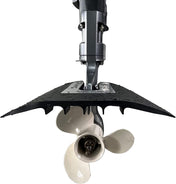
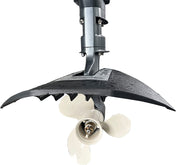
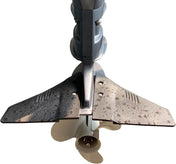
Anode inspection. Sacrificial outboard anodes protect your lower unit, trim tabs, and transom bracket from galvanic corrosion. Replace any anode that's lost more than 50% of its original mass. Saltwater boats eat anodes fast — check them every 50 hours in salt or brackish water.
Grease all fittings. Hit every zerk fitting on the steering, tilt tube, and swivel bracket with marine-grade grease. Mercury calls for 2-4-C Marine Lubricant on pivot points and Quicksilver Special Lubricant 101 on prop shafts.
Every 300 Hours / 3-Year Service
This is the deep service. It's where you catch problems that build up slowly.
Water pump impeller replacement. The rubber impeller inside your lower unit is the only thing keeping your engine cool. After 300 hours, the vanes lose flexibility, crack, and break off. Broken vane pieces travel into the cooling passages and cause blockages that lead to overheating.
Don't just replace the impeller — do the full water pump repair kits with a new wear plate, housing liner, and gaskets. A new impeller against a scored wear plate won't seal properly and you'll lose water pressure.
Inspect the lower unit seals and bearings. Prop shaft seals and shift shaft seals wear over time. If you noticed any water intrusion during gear lube changes, this is when you tear down and replace seals. Driveshaft splines should be inspected for wear and re-greased.
Fuel system service. On carbureted Mercury models (older two-strokes), remove and clean the carburetors. On EFI models, inspect the fuel injectors and check fuel pressure — Mercury FourStroke fuel systems run at approximately 39 psi at idle. Replace all fuel hoses that show cracking or hardening.
Timing belt (Verado only). Mercury Verado supercharged engines use a timing belt that Mercury recommends inspecting at 300 hours and replacing based on condition. Most technicians replace it by 600 hours regardless. This isn't a "maybe" item — a snapped timing belt on an interference engine destroys valves and pistons.
Power steering fluid (Verado). Check the fluid level and condition. Dark or burnt-smelling fluid means it's time for a flush and refill.
Seasonal Maintenance
If you're storing your Mercury outboard for winter (or any extended downoff period over 30 days), do this before it sits.
Fog the engine. Run Mercury Storage Seal or equivalent fogging oil through the intake while the engine runs, then shut it off. This coats the cylinder walls and prevents corrosion during storage.
Stabilize the fuel. Add fuel stabilizer to a full tank (not a partial tank — air space invites condensation). Run the engine for 10 minutes to cycle treated fuel through the system. Ethanol-blended fuel starts breaking down within 30 days without stabilizer.
Disconnect the battery. Or connect a battery maintainer. A dead battery over winter sulfates the plates and kills capacity permanently.
Flush the cooling system. Attach a garden hose to the flush port or use flush muffs. Run fresh water through the engine for at least 5 minutes. Saltwater left in cooling passages over winter turns into a rock-hard deposit that blocks flow.
Lower the engine or trim it down. Storing the engine trimmed up lets water pool in the exhaust relief ports and lower unit cavities.
Model-Specific Notes (FourStroke, OptiMax, Verado)
Not all Mercury outboards are the same under the cowl. Here's what matters for each platform.
Mercury FourStroke (75–300 HP): These are the most straightforward to maintain. Standard oil-and-filter service, conventional water pump, no power steering fluid to worry about (except on hydraulic steering-equipped rigs). The 150 FourStroke is one of Mercury's best sellers and shares many Mercury outboard parts with the 115 and 200 models.
Mercury OptiMax (75–300 HP, discontinued but still widely used): These are direct-injected two-strokes. They burn oil by design — about 1 quart per 50 gallons of fuel. The DFI oil reservoir needs to be topped off regularly. The air compressor that pressurizes fuel injection is a failure point; listen for unusual noise and check compressor oil level. OptiMax engines are also sensitive to fuel quality — they don't tolerate more than 10% ethanol.
Mercury Verado (135–400 HP): The Verado is a supercharged FourStroke with a separate charge air cooler, power steering system, and mechanical supercharger. That means more service points: supercharger oil (check every 100 hours, change every 300), power steering fluid, and a charge air cooler that needs periodic inspection for salt buildup. The L6 Verado (200–400 HP) uses a unique top-cowl mounted oil filter and holds approximately 7 quarts of oil.
FAQ
How much does a full annual Mercury service cost? At a dealer, expect $400–$700 for a 100-hour service depending on the model. DIY with quality parts cuts that to $80–$150 in materials. Service and maintenance kits bundle the consumables you need for annual service at a fraction of dealer pricing.
Can I use aftermarket parts on my Mercury outboard? Yes, but quality matters. OEM Mercury parts are built to spec and fit perfectly, but they carry a 30–50% brand markup. Generic aftermarket parts are cheaper, but quality varies wildly — a bad impeller or seal can cause real engine damage. SeaSierra sources parts from the same factories that produce for OEM brands, so you get identical materials and production standards without the brand-name premium. For consumable parts like impellers, seals, anodes, and gaskets, that's OEM reliability at aftermarket prices.
What happens if I skip the water pump service? The impeller fails progressively, not suddenly. You'll notice a gradual decrease in the telltale stream, then intermittent overheating alarms, then a full overheat event. By the time the alarm sounds, you've likely already warped a head or damaged head gaskets. The $150 water pump kit is far cheaper than the $3,000+ powerhead repair.
Is the 20-hour break-in service really necessary? Absolutely. Cut open a break-in oil filter — it's full of fine metal particles from piston rings seating against cylinder walls and gears wearing into each other. Leave that contaminated oil circulating and you're grinding your engine down from the inside.
Bottom Line
Mercury outboards are reliable when they're maintained on schedule. The intervals aren't suggestions — they're based on real wear patterns that Mercury's engineers have documented across millions of operating hours. Stick to the 20/100/300-hour schedule, use quality parts, and your Mercury will run strong for thousands of hours.
Stock up on the consumables you'll need for each interval: water pump repair kits, fuel filters, anodes, and lower unit seal kits. Having parts on hand means you'll actually do the work when it's due, instead of putting it off because you need to order something.