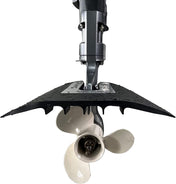
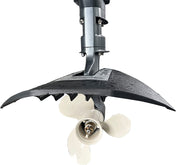
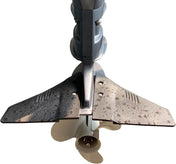
Mounting height is one of the most overlooked factors affecting outboard performance. An engine mounted too low creates unnecessary drag. Too high, and you get ventilation problems and overheating risks.
Finding the optimal height improves speed, fuel economy, and handling.
Table of Contents
- Why Mounting Height Matters
- Understanding Transom Height
- How to Measure Current Position
- Finding Optimal Height
- Adjusting Mounting Height
- FAQ
Why Mounting Height Matters
The relationship between your propeller and the water surface significantly affects performance:
Too low (common):
- Cavitation plate drags in water
- Increased fuel consumption
- Lower top speed
- Engine works harder
Too high:
- Propeller breaks water surface (ventilation)
- Engine over-revs
- Cooling water intake issues
- Inconsistent thrust
Optimal:
- Minimal drag
- Maximum efficiency
- Proper cooling
- Best hole shot and top speed
Most boats come with engines mounted conservatively low. There's often room for improvement.
Understanding Transom Height
Standard Transom Heights
Outboard shaft lengths are designed for standard transom heights:
| Shaft Length | Transom Height | Common Use |
|---|---|---|
| Short (15") | 15" transom | Small boats, dinghies |
| Long (20") | 20" transom | Most runabouts, bass boats |
| Extra-long (25") | 25" transom | Large boats, some offshore |
| Ultra-long (30") | 30" transom | High-transom offshore |
The shaft length should match your transom height as a starting point.
What the Numbers Mean
Shaft length is measured from the mounting bracket to the cavitation plate. Transom height is measured from the bottom of the hull to the top of the transom.
When properly matched, the anti-ventilation (cavitation) plate should be:
- Approximately level with or slightly above the hull bottom
- 1-2 inches above the hull bottom for performance applications
How to Measure Current Position
The Baseline Measurement
- With boat in the water or on a trailer (level)
- Stand behind the boat
- Measure from bottom of hull (at transom) to the anti-ventilation plate
Recording Reference Points
Before making changes:
- Mark current bolt hole positions
- Measure plate-to-hull distance
- Note current performance (RPM, speed, handling)
This lets you return to the original position if needed.
Visual Indicators
Engine too low:
- Cavitation plate well below hull
- Spray comes from lower unit housing
- Engine struggles to reach WOT RPM
Engine too high:
- Prop breaks surface at speed
- Engine over-revs suddenly
- Tell-tale stream becomes erratic
- Stern drops during acceleration
Finding Optimal Height
The Basic Rule
Start with the anti-ventilation plate level with the hull bottom, then adjust based on:
- Boat type and use
- Loading conditions
- Engine size
- Propeller selection
Adjustment Guidelines
| Boat Type | Recommended Position |
|---|---|
| Bass boat | 1-2" above hull bottom |
| Bay boat | At hull bottom to 1" above |
| Center console | At hull bottom |
| Pontoon | Per manufacturer spec |
| Performance boat | 2-3" above (with setback) |
Testing Process
- Start at conservative height (plate at hull bottom)
- Run at various speeds and conditions
- Note RPM, speed, handling
- Raise engine 1/2" at a time
- Retest after each adjustment
- Stop when problems appear (ventilation, cooling)
- Lower back one position from problem point
What to Watch For
Signs you can go higher:
- Engine reaches WOT RPM easily
- No ventilation in turns or rough water
- Tell-tale flows consistently
- Boat handles well
Signs to lower:
- Prop breaks surface at WOT
- Ventilation in turns
- Tell-tale becomes inconsistent
- Engine over-revs suddenly
Adjusting Mounting Height
Standard Mounting Holes
Most transoms and outboard brackets have multiple mounting holes:
- Typically 1" spacing between holes
- Moving up one hole raises engine 1"
Procedure:
- Support engine weight with hoist or stands
- Remove mounting bolts
- Lower engine to new position
- Reinstall bolts
- Torque to specification
Precision Adjustments
For adjustments smaller than hole spacing:
Spacers:
- Add spacers under mounting bracket
- Available in 1/4", 1/2", 1" thicknesses
- Use stainless steel or marine-grade aluminum
Custom transom plates:
- Aftermarket plates with multiple hole patterns
- Allow finer adjustment increments
Jack Plates
For maximum adjustability:
Manual jack plates:
- Bolt-on, allows on-trailer adjustment
- Typically 4-6" of vertical travel
- $200-400 range
Hydraulic jack plates:
- Adjust height while underway
- Optimal for varying conditions
- $600-1500+ depending on capacity
Jack plates are common on bass boats and performance applications where fine-tuning is valuable.
Setback Considerations
Jack plates also provide setback (moving engine further from transom):
- Increases effective waterline length
- Can improve planing and speed
- Requires adequate transom strength
Effects on Performance
Speed and Efficiency
Raising the engine reduces underwater drag:
- Each inch of raise can add 1-3 mph
- Fuel economy improves as resistance decreases
- Benefits are boat-specific
Hole Shot
Lower mounting helps hole shot:
- Prop stays submerged during acceleration
- Better grip for getting on plane
- Important for heavy loads
Higher mounting can hurt initial acceleration but improves top speed.
Handling
Mounting height affects boat balance:
- Higher mounting shifts weight distribution
- May affect trim tab effectiveness
- Changes bow-up/bow-down tendencies
Cooling
The water intake must remain submerged:
- Too high = insufficient cooling water
- Especially critical in rough water or turns
- Monitor tell-tale carefully when testing higher positions
Brand-Specific Notes
Yamaha
Yamaha outboards perform well with anti-ventilation plate at or slightly above hull bottom. High-performance models often benefit from raised mounting.
Mercury
Mercury outboards Verado models have nose cones designed to reduce drag—these benefit from higher mounting if cooling permits.
Johnson/Evinrude
Johnson/Evinrude E-TEC models are efficient at various heights. Test to find your sweet spot.
Honda and Suzuki
Honda and Suzuki outboards follow standard guidelines. Start conservative and adjust based on testing.
Common Mistakes
Raising too far, too fast:
- Make incremental changes
- Test thoroughly at each position
- Don't sacrifice cooling for speed
Ignoring conditions:
- Height that works in calm water may fail in rough conditions
- Test in the conditions you'll actually use
Forgetting propeller interaction:
- Prop size and pitch affect optimal height
- Re-evaluate height if you change props
Not checking torque:
- After adjustment, verify bolt torque
- Re-check after first few runs
FAQ
What's the easiest way to raise my outboard?
Moving to the next higher mounting hole is simplest if available. Otherwise, spacers under the mounting bracket work well for smaller adjustments.
Will raising my engine void the warranty?
Probably not, unless damage results from improper cooling. Keep the engine within its operating specifications and monitor temperature.
My prop cavitates after raising the engine. What should I do?
Lower the engine back down. Cavitation indicates the prop is too close to the surface for your boat's design.
Does mounting height affect trim range?
Yes. Higher mounting may require less trim, while lower mounting may need more trim to achieve optimal running angle.
I have a pontoon. Should I raise the engine?
Pontoons typically need engines at manufacturer-specified heights due to unique hull characteristics. Consult your pontoon manufacturer.
Bottom Line
Mounting height significantly affects outboard performance. Most boats come with engines mounted conservatively, leaving room for optimization. Start at the anti-ventilation plate level with hull bottom, then test higher positions incrementally. Stop before you experience ventilation or cooling problems. A jack plate offers maximum adjustability for serious optimization. Always prioritize reliable cooling over marginal speed gains.