Sacrificial anodes protect your outboard's aluminum and steel components from galvanic corrosion. Pick the wrong material for your water type, and you'll either get inadequate protection or waste money on anodes that corrode too fast.
This guide breaks down when to use each type and how to install them correctly.
Table of Contents
- How Sacrificial Anodes Work
- Zinc, Aluminum, or Magnesium: Quick Comparison
- Choosing by Water Type
- Anode Locations on Your Outboard
- Replacement Steps
- FAQ
How Sacrificial Anodes Work
Galvanic corrosion happens when two different metals sit in an electrolyte (water). One metal becomes the anode and corrodes. The other becomes the cathode and stays protected.
Your outboard has aluminum housings, steel fasteners, and bronze or stainless components—all different metals. Without a sacrificial anode, the aluminum lower unit housing would corrode first.
By bolting on a more reactive metal (zinc, aluminum, or magnesium), you force that metal to corrode instead. It "sacrifices" itself to protect the expensive parts.
The key: your anode must be more electrically active than everything else on the outboard. But not so active that it wastes away in weeks.
Zinc, Aluminum, or Magnesium: Quick Comparison
| Property | Zinc | Aluminum | Magnesium |
|---|---|---|---|
| Best for | Saltwater | Salt/Brackish | Freshwater |
| Driving voltage | -1.05V | -1.10V | -1.55V |
| Consumption rate | 23 lbs/amp-year | 6.6 lbs/amp-year | 8.4 lbs/amp-year |
| Self-corrosion | Low | Very low | Higher |
| Cost | Medium | Medium | Low |
| Lifespan (typical) | 1 season | 1-2 seasons | 6-12 months |
Driving voltage determines protection strength. Higher voltage = more protection = faster consumption.
Choosing by Water Type
Saltwater: Zinc or Aluminum
Saltwater's high conductivity makes corrosion aggressive. Zinc has been the standard for decades—it corrodes at a steady rate and provides reliable protection.
Aluminum anodes are newer but gaining ground. They last longer than zinc, provide slightly better protection, and don't form the calcium buildup that zinc does. Many marine pros now recommend aluminum over zinc for saltwater.
Avoid magnesium in saltwater. It's too reactive—you'll burn through anodes monthly, and the rapid corrosion can actually cause problems.
Brackish Water: Aluminum
Brackish water (estuaries, river mouths, coastal areas with freshwater mixing) is tricky. Salinity varies with tides and seasons.
Aluminum anodes handle this best. They work across a wider conductivity range than zinc. Zinc can become "passive" in lower-salinity water, forming an oxide layer that stops it from protecting.
Freshwater: Magnesium
Freshwater has low conductivity, so zinc and aluminum anodes don't corrode enough to provide protection. They just sit there while your lower unit corrodes instead.
Magnesium's higher driving voltage generates enough current to protect in low-conductivity water. Yes, it'll need replacing more often—but it's actually working.
Important exception: If your boat sits in a marina with shore power, or near other boats with electrical issues, you might experience stray current corrosion. In that case, aluminum can work in freshwater. But for typical freshwater use, magnesium is the right choice.
Anode Locations on Your Outboard
Most outboards have anodes in these locations:
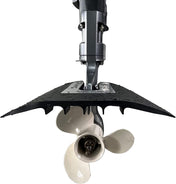
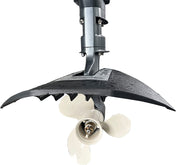
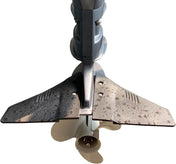
Lower unit trim tab anode: The large fin-shaped anode on the back of the lower unit. Usually the biggest and most visible. Protects the lower unit housing.
Transom bracket anodes: Small disc or button anodes on the mounting brackets. Protects the bracket and transom area.
Internal anodes: Yamaha F150 and larger models have an anode inside the exhaust housing. Mercury Verados have internal anodes in the gearcase. Check your service manual.
Power trim cylinder anode: Some outboards have a small anode on the trim/tilt unit.
Count your anodes before ordering. A typical 75-150 HP outboard has 2-4 anodes.
Replacement Steps
Tools Needed
- Socket set (10mm, 12mm common)
- Wrench set
- Wire brush
- Marine-grade anti-seize
- Torque wrench
Step 1: Remove the Old Anode
Most anodes bolt on. The trim tab anode typically has a single 10mm or 3/8" bolt through the center.
If the bolt is seized, soak it with penetrating oil overnight. Heating the surrounding area with a heat gun can help—but avoid open flame near fuel components.
Don't use an impact driver on small anode bolts. You'll strip the threads in the aluminum housing.
Step 2: Clean the Mounting Surface
Use a wire brush to remove corrosion and old anode material from the mounting surface. Good metal-to-metal contact is critical—anodes don't work through paint, corrosion, or oxidation.
On Johnson/Evinrude outboards, check for paint buildup around the mounting area. Factory paint sometimes needs scraping to expose bare metal.
Step 3: Install the New Anode
Apply a thin coat of anti-seize to the bolt threads—this prevents galvanic bonding between the stainless bolt and aluminum housing.
Don't paint anodes. Don't coat them with anti-fouling. They need direct water contact to work.
Torque specs vary: - Small button anodes: 8-10 ft-lbs - Trim tab anodes: 12-15 ft-lbs
Step 4: Check Electrical Continuity
The anode must have electrical continuity to the parts it protects. After installation, use a multimeter set to continuity. Touch one probe to the anode, the other to the lower unit housing. You should get a tone or near-zero resistance.
If not, the mounting surface isn't clean enough, or there's paint between the anode and housing.
When to Replace
Replace anodes when they're 50% consumed—not when they're completely gone. By the time an anode disappears, your lower unit has been unprotected for months.
Check anodes at every oil change or at least twice per season. In aggressive saltwater environments, monthly inspections are smart.
Signs of problems: - Anode less than half original thickness - White powdery buildup (zinc) or pitting (aluminum) - Corrosion appearing on the lower unit housing - Multiple anodes disappearing unevenly (possible stray current issue)
FAQ
Can I mix anode types on the same outboard?
Not recommended. Different anode materials have different voltages, which can create their own galvanic cell. Pick one type and use it for all anodes.
My zinc anodes aren't corroding at all in freshwater. Is that good?
No—it means they're not protecting anything. Zinc becomes passive in low-conductivity water. Switch to magnesium anodes for freshwater.
Are aftermarket anodes as good as OEM?
Quality varies. Cheap imports often have impure metal that corrodes unevenly or not at all. Anodes from reputable marine parts suppliers like SeaSierra meet the same mil-spec standards as OEM—because they come from the same factories that supply OEM manufacturers.
How do I know if I have stray current corrosion?
Stray current corrosion is much faster than galvanic corrosion. If you're going through anodes in weeks instead of months, or if corrosion appears rapidly on multiple boats in your marina, stray current is likely. You'll need an ABYC-certified marine electrician to diagnose and fix it.
Should I remove anodes for freshwater storage?
No. Leave them installed. Even in storage, condensation and humidity can cause corrosion. Anodes provide protection as long as any moisture is present.
The Bottom Line
Match your anode material to your water type: zinc or aluminum for saltwater, aluminum for brackish, magnesium for freshwater. Replace at 50% consumption, and make sure you have clean metal-to-metal contact.
A full set of anodes costs $20-50. A corroded lower unit housing costs $800-2,000. The math is simple.