If your outboard is shaking, rattling, or sending vibrations through the transom, something is off — and ignoring it will only make things worse. Outboard vibration causes range from a dinged prop to internal engine problems, and the fix can be as simple as tightening a bolt or as involved as replacing a lower unit component. This guide walks you through diagnosis and repair, starting with the most likely culprits.
Table of Contents
- What's Happening
- Quick Diagnosis Checklist
- Causes and Fixes
- When You Need a Mechanic
- Preventing This Problem
- FAQ
- Bottom Line
What's Happening
A healthy outboard runs smooth. When you feel vibration — whether it's a constant hum, a rhythmic pulse at certain RPMs, or a harsh shudder under load — the engine, drivetrain, or mounting system is telling you something is out of balance, worn, or loose.
Boat motor vibration typically falls into three categories:
- Propeller-related — the most common source, accounting for roughly 60-70% of vibration complaints
- Mounting and alignment issues — loose bolts, worn rubber mounts, or improper transom fit
- Internal drivetrain or engine problems — worn bearings, damaged gears, or misfiring cylinders
The key is figuring out when the vibration happens. At idle? Under acceleration? At a specific RPM range? Only in gear? That timing tells you where to look.
Quick Diagnosis Checklist
Before you start pulling things apart, run through this quick assessment:
- [ ] Visual prop inspection — Pull the prop and look for bent blades, missing chunks, fishing line wrapped around the shaft, or a spun hub
- [ ] Check mounting bolts — Verify all transom bolts are torqued to spec (typically 30-35 ft-lbs for most outboards; check your service manual)
- [ ] Run at idle in neutral — If vibration is present in neutral, the problem is engine-side, not prop or drivetrain
- [ ] Run at idle in gear — New vibration appearing in gear points to the lower unit or prop
- [ ] Check engine mounts — Look for cracked, compressed, or oil-soaked rubber isolators
- [ ] Inspect the skeg and lower unit — Damage here affects water flow and creates turbulence-driven vibration
- [ ] Pull spark plugs — Uneven coloring across cylinders suggests a misfire contributing to rough running
Causes and Fixes
1. Damaged or Unbalanced Propeller
The single most common cause of outboard vibration. A blade that's bent even 2-3mm out of true will create noticeable shaking above 2,500 RPM. A spun hub — where the rubber insert between the prop and hub loses grip — causes a different kind of vibration: a slipping, inconsistent feel under load with a sudden RPM spike.
What to do:
- Remove the prop and inspect every blade. Run your finger along each edge — you're feeling for nicks, bends, and uneven surfaces.
- Place the prop on a flat surface. All blade tips should sit at the same height. Any deviation over 1.5mm means it needs repair or replacement.
- Check the hub by gripping a blade and trying to rotate the prop on the hub. Any movement means the hub is spun.
- If you're running an aluminum prop that's been repaired more than twice, it's time for a new one. Repeated straightening weakens the metal and throws off balance.
A quality replacement outboard propeller matched to your engine's specs will eliminate prop-related vibration immediately. When choosing a replacement, stick with the same pitch and diameter as your original — changing specs solves vibration but can create performance issues if you haven't done the math on your boat's load and hull type.
2. Loose or Worn Engine Mounts
Outboard mounting bolts handle enormous stress. The rubber isolators in the mounting bracket absorb vibration, but after 5-8 years (or fewer in saltwater), they compress, crack, and harden. Once they lose elasticity, every engine pulse transfers straight to the transom and hull.
What to do:
- Torque-check all mounting hardware. Re-torque to manufacturer spec.
- Inspect rubber mounts for visible cracking or deformation. Press firmly with your thumb — healthy rubber springs back immediately. Dead rubber stays compressed.
- On tiller-steer models (especially older Yamaha 2-strokes and Mercury 9.9/15hp), check the swivel bracket bushings. Worn bushings here create a vibration that feels like it's coming from the engine but is actually mechanical slop.
3. Fouled or Failing Spark Plug / Misfire
A cylinder that's not firing properly throws the engine out of balance. On a 4-cylinder outboard, one dead cylinder increases vibration by roughly 25%. On a twin-cylinder, it's immediately obvious — the engine will barely run.
What to do:
- Pull all spark plugs and compare. A plug that's noticeably darker, oily, or white compared to the others indicates a problem in that cylinder.
- Check spark plug gap against spec (typically 0.028-0.035" for most outboards).
- On fuel-injected models, swap injectors between cylinders. If the misfire follows the injector, you've found your problem.
- For carbureted engines, a rough idle that smooths out at higher RPM often points to a clogged pilot jet.
4. Bent Prop Shaft or Damaged Lower Unit
Hit a rock or ran aground? Even if the prop looks fine, the shaft behind it may be bent. A prop shaft that's off by just 0.005" (0.13mm) creates serious vibration at speed. You can check this with a dial indicator if you have one — mount it against the shaft and rotate slowly. Total indicated runout (TIR) should be under 0.003" for smooth operation.
Internal lower unit damage — chipped gear teeth, worn bearings, or a failing carrier bearing — produces a growling vibration that gets worse under load. If you notice metallic particles in your lower unit oil during a change, something inside is wearing.
What to do:
- If the shaft is bent, it needs replacement. This is a lower unit teardown job.
- While the lower unit is apart, replace seals and bearings as a set. Lower unit seal kits matched to your engine model ensure everything goes back together to factory spec without the guesswork of sourcing individual seals.
5. Cavitation and Ventilation Issues
If vibration only occurs at certain speeds or during turns, you may have a cavitation or ventilation problem rather than a mechanical fault. A damaged skeg, incorrect engine height, or worn anti-ventilation plate causes the prop to lose its grip on the water, creating a shuddering vibration with an audible RPM increase.
What to do:
- Check engine mounting height. The anti-ventilation plate should sit roughly 1" (25mm) above the hull bottom for most applications.
- Inspect the skeg for damage. A broken or worn skeg disrupts water flow to the propeller.
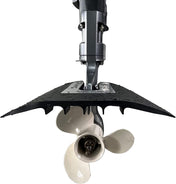
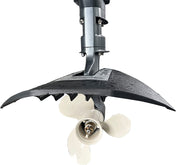
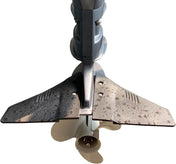
- Consider adding hydrofoil stabilizers to improve water flow and reduce cavitation, especially on lighter boats or engines mounted slightly high.
6. Corrosion-Related Imbalance
Severe corrosion on the lower unit, skeg, or prop creates uneven surfaces that disrupt water flow. More critically, galvanic corrosion eats into metal unevenly, throwing rotating components out of balance.
What to do:
- Inspect and replace sacrificial outboard anodes if they're more than 50% depleted. Anodes are your first line of defense against corrosion — they're designed to corrode so your engine doesn't.
- In saltwater or brackish environments, check anodes at least every 3 months.
When You Need a Mechanic
Handle prop swaps, mount checks, and spark plug inspections yourself. But call a qualified marine mechanic if:
- You find metal shavings in lower unit oil
- The prop shaft has measurable runout beyond 0.005"
- Vibration persists after addressing all the items above
- You hear grinding, knocking, or clicking from the lower unit under load
- The powerhead has uneven compression across cylinders (variation greater than 10% between the highest and lowest readings)
Internal lower unit and powerhead work requires specialized tools and precise tolerances. A misassembled lower unit will fail quickly and expensively.
Preventing This Problem
- Inspect your prop before every outing. Takes 30 seconds. Run your hand along the blades and check for play on the hub.
- Change lower unit oil every 100 hours or annually — whichever comes first. Check the old oil for water (milky appearance) and metal particles.
- Maintain your anodes. Replace them before they're fully depleted, not after.
- Torque-check mounting hardware at the start of each season. Vibration loosens bolts, and loose bolts create more vibration — a cycle that escalates quickly.
- Flush your engine after every saltwater use. Corrosion buildup inside the cooling passages can cause uneven heating and expansion, contributing to rough running.
- Keep a spare prop on board. If you damage a blade mid-trip, swapping it out immediately prevents shaft and bearing damage from running an unbalanced prop.
FAQ
My outboard vibrates only at 3,000-3,500 RPM but smooths out above and below. What's going on? This is a resonance issue. At certain RPMs, the engine's natural frequency matches the hull or mounting structure, amplifying vibration. Try adjusting idle speed slightly, checking mount tightness, or adding a hydrofoil to shift the harmonic. Some Yamaha F150 and Mercury 115 FourStroke owners report this in the 3,000-3,200 RPM range — it's a known characteristic, not necessarily a defect.
Can a prop repair shop fix vibration, or do I need a new prop? A good prop shop can fix minor bends and nicks and re-balance the prop. But if a blade has been bent severely or repaired multiple times, replacement is the better long-term move. An out-of-balance prop puts stress on shaft bearings and seals with every rotation.
I just installed a new prop and now I have vibration I didn't have before. What happened? Check that the thrust washer and spacer are installed correctly and in the right order — getting these reversed is a common mistake. Also verify you're using the correct prop for your engine. A prop that's too large in diameter can create excessive load and vibration, especially on smaller outboards.
Is some vibration normal? Yes. Outboards are not luxury car engines. A slight hum or buzz is expected, particularly on older 2-stroke models. What's not normal is vibration that changes suddenly, gets worse over time, or is accompanied by unusual noise.
Bottom Line
Most outboard vibration traces back to the prop — start there. A careful inspection followed by a systematic check of mounts, ignition, and the lower unit will identify the source in the vast majority of cases. When you need replacement parts, quality matters: a prop or seal kit built to the same production standards as the original keeps vibration where it should be — essentially zero. Fix it early, and you avoid the cascade of bearing wear, seal failure, and structural fatigue that turns a simple vibration into an expensive rebuild.