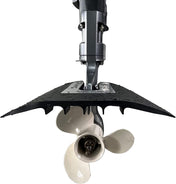
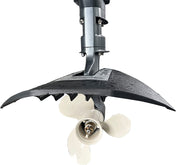
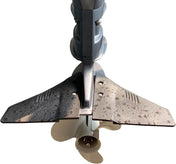
The numbers stamped on your propeller—like 13 x 19 or 14.5 x 17—mean something specific. Understanding pitch and diameter helps you select a prop that lets your engine reach proper RPM, maximizes efficiency, and matches your typical use.
Table of Contents
- Understanding Prop Specifications
- How Pitch Affects Performance
- How Diameter Affects Performance
- Finding the Right Pitch
- Other Factors in Prop Selection
- FAQ
Understanding Prop Specifications
When you see "14 x 21" on a propeller, here's what it means:
First number (14): Diameter in inches—the circle swept by the blade tips
Second number (21): Pitch in inches—theoretical forward travel per revolution
A 14 x 21 prop has a 14-inch diameter and 21-inch pitch.
Pitch Explained Simply
Think of pitch like the gears on a bicycle. Lower pitch (like a lower gear) gives more pulling power but less top speed. Higher pitch (like a higher gear) gives more speed but less acceleration.
Pitch is the theoretical distance the prop would travel forward in one revolution if there were no slip. A 21-pitch prop would move 21 inches forward per revolution in a perfect world.
In reality, props slip 10-30% depending on conditions. A 21-pitch prop might actually advance 15-19 inches per revolution.
Diameter Explained
Diameter determines how much water the prop can "grab." Larger diameter moves more water but requires more power to turn. Smaller diameter spins easier but moves less water.
Diameter is largely determined by your engine size and boat design. Most boaters don't change diameter unless making significant changes to their setup.
How Pitch Affects Performance
Lower Pitch (Smaller Number)
- Engine reaches higher RPM for given throttle
- Better acceleration ("hole shot")
- Better for heavy loads
- Better for pulling skiers/wakeboarders
- Lower top speed
- Engine may over-rev if too low
Higher Pitch (Larger Number)
- Engine runs at lower RPM for given throttle
- Higher top speed potential
- Better fuel efficiency at cruise
- Less acceleration
- Engine may lug (under-rev) if too high
- Hard on engine if it can't reach proper RPM
The Rule of Thumb
Each 1 inch of pitch change = approximately 150-200 RPM change
Going from a 19-pitch to a 21-pitch prop will reduce your wide-open-throttle (WOT) RPM by roughly 300-400 RPM.
How Diameter Affects Performance
Diameter changes are less common but have significant effects:
Larger Diameter
- Moves more water per revolution
- Better "grip" for acceleration
- May reduce top speed if engine can't turn it
- Can increase cavitation if too large for application
Smaller Diameter
- Easier for engine to turn
- May allow higher RPM
- Less thrust per revolution
- Better for high-speed applications
General rule: Stay within 1 inch of OEM diameter unless you have a specific reason to change.
Finding the Right Pitch
Step 1: Establish Your WOT RPM
Every engine has a recommended wide-open-throttle RPM range—the RPM the engine should achieve at full throttle under normal load.
| Brand | Typical WOT Range |
|---|---|
| Yamaha | 5000-6000 RPM (varies by model) |
| Mercury | 5000-6000 RPM (varies by model) |
| Honda | 5000-6000 RPM (varies by model) |
| Suzuki | 5500-6300 RPM (varies by model) |
Check your engine's specifications for the exact range.
Step 2: Test Your Current Setup
Run your boat at wide-open throttle with your typical load (passengers, gear, fuel level). Note the maximum RPM achieved.
Step 3: Compare to Specifications
WOT RPM at top of range: Prop pitch may be slightly low. You could go up in pitch for better top speed and fuel economy.
WOT RPM in the middle of range: Ideal. Good balance of performance.
WOT RPM at bottom of range or below: Prop pitch is too high. Engine is lugging. Go down in pitch.
Step 4: Calculate Needed Change
If your engine's WOT range is 5000-6000 and you're only reaching 4700 RPM:
- You need to gain approximately 300-500 RPM
- That's roughly 2 inches less pitch
- If current prop is 21 pitch, try 19 pitch
Matching Pitch to Use
Bass Fishing / Shallow Water
- Quick acceleration important
- Frequent speed changes
- Recommendation: Lower pitch, stay at top of RPM range
Watersports (Skiing, Wakeboarding)
- Heavy pull-up load
- Need strong acceleration
- Recommendation: Lower pitch, possibly larger diameter
Cruising / Fishing Offshore
- Fuel efficiency priority
- Steady speeds
- Recommendation: Mid-range pitch, hit middle of RPM range
Maximum Speed
- Top speed is goal
- Light load
- Recommendation: Higher pitch, still achieve minimum of RPM range
Other Factors in Prop Selection
Number of Blades
3-blade: Most common. Good balance of efficiency and performance.
4-blade: Better acceleration, improved grip in rough water, slightly reduced top speed, better fuel economy at cruise.
5-blade: Maximum grip, best for heavy boats or rough conditions, reduced top speed.
Blade Material
Aluminum: Affordable, good for recreational use, more prone to damage but cheaper to replace. Find aluminum propellers at SeaSierra.
Stainless steel: Stronger, thinner blades, better performance, lasts longer, more expensive, can damage lower unit if impact doesn't shear the hub.
Blade Shape (Rake and Cup)
Rake: The angle of the blade relative to the hub. Higher rake improves performance at high speed but can reduce acceleration.
Cup: A curve at the blade's trailing edge. Cup improves grip, reduces ventilation, and can add effective pitch.
Hub Design
Rubber hub: Cushions impact, designed to spin and protect gearcase in severe strikes. Standard on most props.
Pressed-in hub: More responsive, less slip, typically found on high-performance props.
Common Mistakes
Over-Propping
Choosing too high a pitch because "higher pitch = higher speed." If the engine can't reach proper RPM, you get neither speed nor efficiency, and you stress the engine.
Ignoring Load Changes
A prop perfect for two passengers may lug the engine with a full load. Consider your typical load, not your lightest configuration.
Single-Prop Solution
Different activities may benefit from different props. Carrying a spare prop with different pitch gives you flexibility.
Testing a New Prop
When trying a new pitch:
- Run GPS speed tests at WOT—note speed and RPM
- Test acceleration from rest
- Test cruise fuel consumption
- Load the boat normally for your typical use
- Compare to previous prop data
Give the prop a full test before deciding—performance can vary with conditions.
FAQ
Can I change pitch without affecting diameter?
Yes, most prop manufacturers offer the same diameter in multiple pitches. This is the most common change.
What if I want better acceleration AND better top speed?
That's the eternal trade-off. You can't have both from pitch alone. Consider a 4-blade prop or different blade design for improved acceleration without sacrificing as much top speed.
How do I know my engine's recommended WOT RPM?
Check your owner's manual or the engine specification plate. It's also usually in online spec sheets for your model.
Is GPS speed or speedometer more accurate for testing?
GPS is more accurate. Speedometers read based on a paddle wheel or pressure tube and can be affected by prop changes.
Do I need to re-pitch if I change from aluminum to stainless?
Often yes. Stainless blades are thinner and have less slip. A stainless prop often performs like an aluminum prop with 1 inch more pitch.
Bottom Line
Proper prop selection means your engine runs in its designed RPM range at wide-open throttle. Too much pitch lugs the engine; too little wastes fuel and limits speed. Start with your engine's recommended WOT RPM, measure what you're actually achieving, and adjust pitch accordingly. Most boaters find their ideal setup within one or two pitch changes.
Find the right propeller for your outboard at SeaSierra.